Category: Uncategorized

  • Defining Autism Spectrum Disorder

    From a clinical perspective, Autism is a group of complex brain disorders oftenly referred to as neurodevelopmental disorders, which uniquely impairs an individuals’ interpretation and participation in their social world. Autism is believed to be present at birth, can be diagnosed during the first three years of life and more easily as social demands increase and lasts throughout a person’s lifetime.

    Autism is characterized by two areas of deficit known as social affect (recognised deficits in social interactions and communication) and excessive repetitions of behaviors or fixated interests. When left unattended, these social behavioural challenges may become more rigid with age.

    In autism, there is bidirectional influence of autism on development and development on autism. for example, development of a child in different domains (physical, social, emotional and cognition) affects symptom expression and symptom expression also affects development. As a disorder of social affect, autism can quickly take an individual very far off from the expected trajectory.


    In practice, autism is not a single condition, it presents a spectrum of closely related conditions with shared symptoms. The impact of symptoms causing disabling interactions, communication and behaviors is highly dependent on symptoms which greatly vary from individual to individual. Each individual on the autism spectrum has some degree of problems with communication, social skills, and flexible behavior.

    Autism Causes

    Since its official identification in the 1940s, autism research shows no single cause for autism. Research tilts towards a combination of contributory factors;

    • Genetic factors including genetic mutations report to be highly determining of autism at 80%.
    • Environmental factors including toxins, infections, stress, child traumatic birth injuries or infections.

    Autism Treatments

    Any condition without a clearly identifiable cause present challenges for treatment. The current state of Autism has led the scientific community and practitioners to search and invent possible treatments to ease the Autism symptoms and or improve developmental outcomes that enhance an individual’s functioning. Today, some treatment options include early intervention programmes with specialized support and training using high efficacy, research-proven behavioural interventions. These methods have recorded optimal outcomes in managing autism symptoms and at the same time enhance meaningful and productive living.

    What Does Autism Look Like?

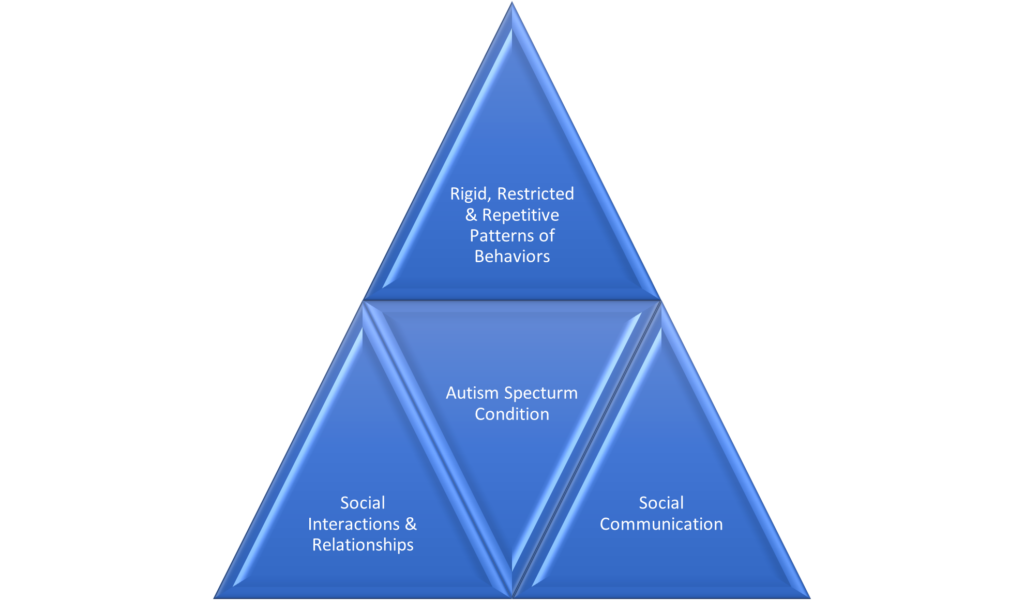
    Autism has no obvious look, meaning one cannot know that someone has autism just by looking at them! With traditional physical disabilities that are easier to identify, many people want to physically see “autism”. More often than not, people say “but he or she does not like!” Because autism by nature is NOT like other obvious disabilities that are easily observed. Autism requires understanding of its presentation and interaction with a person for one to identify. The reason people cannot see autism is because autism deficits are in the brain, which we all cannot see but infer from interactions by specifically recognising difficulties in social communication and behaviors. The individual with autism will exhibit behaviors that substantially deviate from normative ways of behaving shared by majority of the people. Autism only becomes apparent when an individual is not in tune with societal expectations of behaving at given ages. Autism presents a continuum of symptoms and behaviors reflecting varying degrees in relation to severity. The variations in the presentation of symptoms from person to person gives autism its “spectrum” name—each individual uniquely displays a triad of impairments as a result of autism.

    A. Qualitative Impairment in Social Interaction and Relationships

    The social nature endowed in humans is the most widely known challenge for people with Autism. Autism presents difficulties in adhering to rules and principles governing social interactions, primarily because of the way their brains perceive and process socially related information. As a result, people with autism can be more gullible and naive to social behavior and can be easier targets for teasing, bullying and victimization. Some of the impairments observed in social interactions and relationships include but not limited to the following;

    ®    Social isolation and preference for lone play;

    ®    Struggle with seeking out friends or friendships or joining in social exchanges.

    ®    Lacking social awareness (behaving as if other people do not exist).

    ®    Showing disinterest and dislike to engage in social behavior.

    ®    Higher preference for objects than people.

    ®    Lacks spontaneous shared enjoyment, interests and or achievements;

    ®             No showing or pointing out objects.

    ®    Inability to take into account context, social cues and conventions;

    ®             No give-and-take nature of conversations and relationships.

    ®             Lacks turn-taking skills.

    ®             No sharing of objects/toys with others.

    ®             Does not ask for things.

    ®             Does not wait for own turn.

    ®             Lacks joint attention skills.

    ®             Expresses aggression when own needs are not recognised or given

    ®             Struggles negotiating socially.

    ®             Inappropriate touching and closeness to others.

    ®    Problems with social and emotional reciprocity and empathy.

    ®             Emotions are not expressed according—mostly out of tune with reality.

    ®             Difficulties to read or recognise emotions.


    ®             Fails to attune to emotions.

    B. Qualitative Impairments in Social Communication

    Communication is the centre of social life. In order for one to experience good quality and enjoyable life, it is necessary that needs are communicated and met. In the autism world, communication, specifically, lack or limited age-appropriate speech is common. This leads to presents as a great challenge and while looking to understand autism difficulties, parents and practitioners are, at the same time, navigating solutions to enhance ability to communicate. While young, people with autism can often speak fluently and appear to have “typical” expressive and receptive language, they usually present impairments in pragmatic language skills. Pragmatic language refers to the use of language in conversations and relationships. Generally, autism as a spectrum condition presents variant social communication competencies and difficulties. Examples of social communication impairments may include but not limited to the following;

    ®    Common speech difficulties;

    ®    Delay in, or total lack of, the development of spoken language (not accompanied by an attempt to compensate through alternative modes of communication such as gestures).

    ®    Do not respond when name is called.

    ®    Cry inappropriately or melt down when needs are not met.

    ®    Gibberish vocalizations that are hard to make out.

    ®    Lacks eye contact to initiate, terminate or regulate social communication.

    ®    Lack of consistent facial expressions (in response to activity or emotions)

    ®    Little or lack of communicative gesturing (pointing, hand movements)

    ®    Difficulty in comprehending and following instructions.

    ®    Continuously repeating words they have heard from others.

    ®    Uneven development of language and speech skills (not at a typical level of ability, and unevenly)

    ®    Unusual speech prosody (rhythm/intonation).

    ®    Difficulties understanding implied meaning, interpret what is said literally.

    ®    Struggle with general conversational rules;

    ®     Inappropriately gaining and maintaining another’s attention.

    ®    Swapping between listener and speaker role.

    ®    Difficulties choosing and staying on topic.

    ®    Getting lost in details and losing the point in an exchange.

    ®    Pragmatic language difficulties include challenges;

    ®    Not getting what was communicated when unsure.

    ®    Behave like they understand what is communicated, when in fact they do not.

    ®    Share difference of opinion.

    ®    Want more information or clarification.


    ®    Difficulties expressing thoughts, opinions, emotions or needs—may use physical means like kick, hit, scream to say that they are not happy.  

    C. Rigid, Restricted, Repetitive Patterns of Behaviors, Interests and Activities.

    • Playing with objects/toys in a stereotyped manner.
    • Stereotyped patterns of interest that is abnormal either in intensity or focus.
    • Unusual play with objects;
      • Spinning objects
      • Sniffing foods and objects
      • Lining up toys
      • Categorising toys by color or patterns
    • Fixed adherence to specific, non-functional routines or rituals.
      • Putting on shoes (E.g. starting with the specific side of the foot even when the opposite is presented).
      • Going to the same room to pick a toy or a book before starting the day.
      • Rigid thinking patterns or preference for predictability, routine and consistency.
    • Difficulties managing change or transitions between activities.
    • Stereotyped and repetitive motor mannerisms (e.g., hand-flapping or twisting, observing own hand or fingers, complex body mannerisms, running in circles).
    • Attachment to play objects—trampoline, swing, blanket, stuffed animal, cooking stick, spoon, shoe in

    D. Additional difficulties observed in Autism

        i.  Sensory sensitivities

    Hyper/Hypo sensitivities

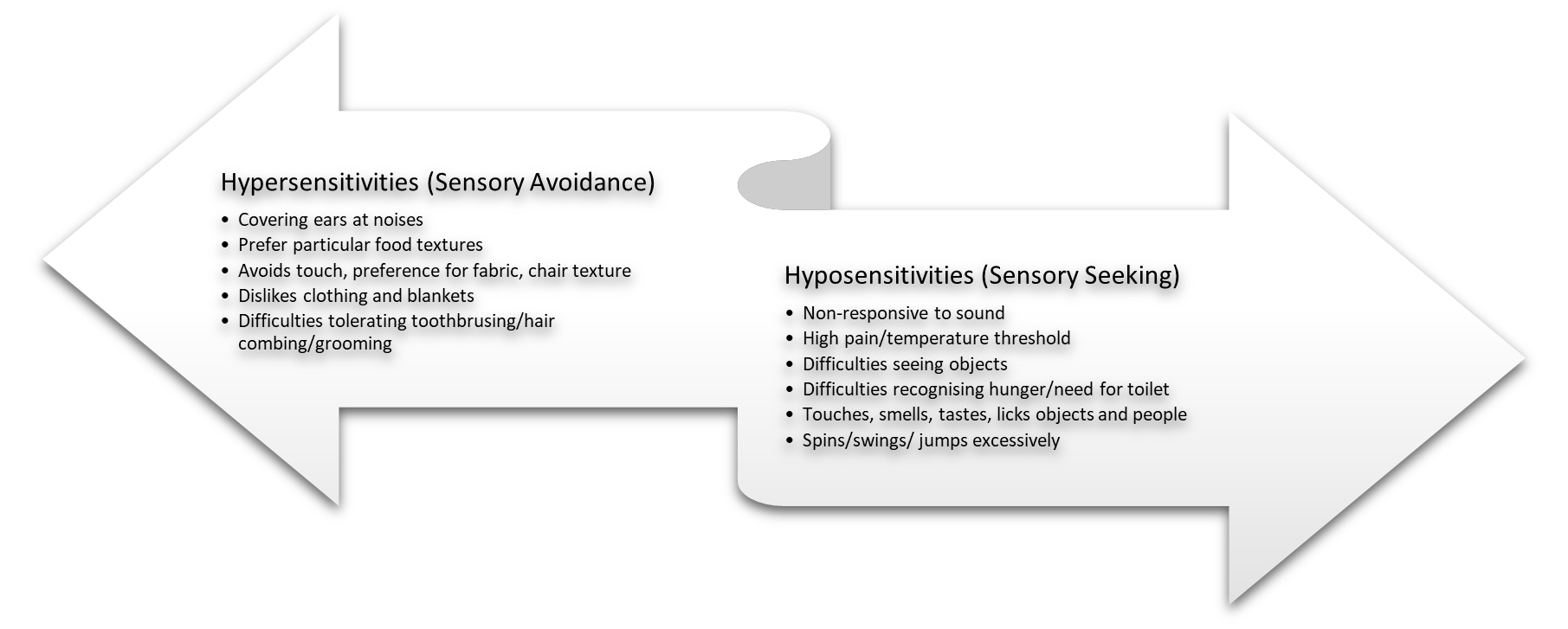
    Challenges with sensitivities come from sensory interaction with the environment and interpretation thereof. While these sensitivities fall on a continuum, many individuals with autism experience these on two extremes—hyper (overly) or hypo (low) sensitivity to sensory experiences. The hypersensitivities are often recognised as “sensory avoiders” require very light sensory stimulation in the senses to experience a reaction. Those with hyposensitivities, often referred to as “sensory seekers” may not react to sensory stimuli because it is poorly registered or recognised to elicit a reaction. Examples of hyper/hypo sensitivities may include but not limited to the following;

    ii.         Fine and Gross Motor Difficulties

    Clumsiness and poor handwriting

    Problems with adaptive functioning

    Personal care and independent living skills

    iii.         Theory of Mind

    Theory of Mind (ToM) refers to the ability to put oneself in another’s shoes, literally taking their cognitive, emotional and visual perspective. This process equips children with skill for social interaction, group dynamics and behavior (Peterson, Slaughter, Peterson & Premack, 2013). For autism, the inability to appreciate the group perspective produces mind-blindness as a result, many people with autism experience difficulties understanding emotions, thoughts and intentions in themselves and others (Baron-Cohen, 1995). By adolescence, most individuals with Autism would pass a basic ToM test and are likely to be aware of the factual information known by another. However, they have difficulties to imagine the ways in which the other person perceives the factual information, or the emotions that they have in response to it. Major ways in which the Theory of Mind impairs social communication is illustrated in Figure 4 below:


    iv.         Central Coherence

    Central coherence (CC) is the ability to integrate pieces of information into a whole (Happe & Frith, 1996). With very weak central coherence, a person with Autism focuses on details without attending to the central meaning. Strong central coherence enables someone to comprehend and remember the gist of a conversation, story or situation and to integrate multiple cues to get a sense of the whole. Weak central coherence can impact the young person in a number of ways:

    Weak central coherence

          If every detail is important, changes to the environment might be overwhelming.

          If someone remembers where everything is placed, moving things around maybe a source of distress.

          Challenges to integrating multiple stimuli might lead to difficulty noticing and responding to others’ emotions.

          If every detail is important, a change may result in something that has to be learned new, rather than being understood as something that is essentially similar

          The ability to generalise is difficult.

          Challenges attending to and integrating a range of types of cues, rather than the ‘whole’ of a social scene might lead to misinterpretation, faulty conclusions and eventual inappropriate solutions.

    v.         Executive Functioning

    Executive functions (EF) refer to higher-order cognitive processes such as the ability to adapt behaviour to a changing situation, to plan and organise future behaviour, and to think abstractly. It is important to recognise that challenges in cognitive deficits are not permanent. Research shows that interventions in childhood, as well as family adaptation and individual compensatory strategies, make deficits less intrusive in adolescence.  Below are executive function difficulties in autism;

          Planning and organisation

          Predicting ahead and planning to achieve a desired outcome, or avoid a pitfall.

          Concentrating, dividing attention, or shifting attention from one activity to another.

          Impulse control problems: knowing how to start and stop particular behaviours.

          Getting started with a task or conversation.

          Reflecting on past experiences and adapting what has worked or did not work.

          Understanding the passage of time particularly trouble estimating time frames, losing track of time, prolonging a conversation topic or having particular expectations about start and end times for sessions

          Adapting to new situations.


  • Defining Autism Spectrum Disorder

    Defining Autism Spectrum Disorder

    From a clinical perspective, Autism is a group of complex brain disorders oftenly referred to as neurodevelopmental disorders, which uniquely impairs an individuals’ interpretation and participation in their social world. Autism is believed to be present at birth, can be diagnosed during the first three years of life and more easily as social demands increase and lasts throughout a person’s lifetime. Autism is characterized by two areas of deficit known as social affect (recognised deficits in social interactions and communication) and excessive repetitions of behaviors or fixated interests. When left unattended, these social behavioural challenges may become more rigid with age. In autism, there is bidirectional influence of autism on development and development on autism. for example, development of a child in different domains (physical, social, emotional and cognition) affects symptom expression and symptom expression also affects development. As a disorder of social affect, autism can quickly take an individual very far off from the expected trajectory. In practice, autism is not a single condition, it presents a spectrum of closely related conditions with shared symptoms. The impact of symptoms causing disabling interactions, communication and behaviors is highly dependent on symptoms which greatly vary from individual to individual. Each individual on the autism spectrum has some degree of problems with communication, social skills, and flexible behavior.

    Autism Causes

    Since its official identification in the 1940s, autism research shows no single cause for autism. Research tilts towards a combination of contributory factors;

    • Genetic factors including genetic mutations report to be highly determining of autism at 80%.
    • Environmental factors including toxins, infections, stress, child traumatic birth injuries or infections.

    Autism Treatments

    Any condition without a clearly identifiable cause present challenges for treatment. The current state of Autism has led the scientific community and practitioners to search and invent possible treatments to ease the Autism symptoms and or improve developmental outcomes that enhance an individual’s functioning. Today, some treatment options include early intervention programmes with specialized support and training using high efficacy, research-proven behavioural interventions. These methods have recorded optimal outcomes in managing autism symptoms and at the same time enhance meaningful and productive living.

    What Does Autism Look Like?

    Autism has no obvious look, meaning one cannot know that someone has autism just by looking at them! With traditional physical disabilities that are easier to identify, many people want to physically see “autism”. More often than not, people say “but he or she does not like!” Because autism by nature is NOT like other obvious disabilities that are easily observed. Autism requires understanding of its presentation and interaction with a person for one to identify. 

    The reason people cannot see autism is because autism deficits are in the brain, which we all cannot see but infer from interactions by specifically recognising difficulties in social communication and behaviors. The individual with autism will exhibit behaviors that substantially deviate from normative ways of behaving shared by majority of the people. Autism only becomes apparent when an individual is not in tune with societal expectations of behaving at given ages. 

    Autism presents a continuum of symptoms and behaviors reflecting varying degrees in relation to severity. The variations in the presentation of symptoms from person to person gives autism its “spectrum” name—each individual uniquely displays a triad of impairments as a result of autism.

    A. Qualitative Impairment in Social Interaction and Relationships

    The social nature endowed in humans is the most widely known challenge for people with Autism. Autism presents difficulties in adhering to rules and principles governing social interactions, primarily because of the way their brains perceive and process socially related information. As a result, people with autism can be more gullible and naive to social behavior and can be easier targets for teasing, bullying and victimization. Some of the impairments observed in social interactions and relationships include but not limited to the following; 

    1. Social isolation and preference for lone play;

      • Struggle with seeking out friends or friendships or joining in social exchanges.
      • Lacking social awareness (behaving as if other people do not exist).
      • Showing disinterest and dislike to engage in social behavior.
      • Higher preference for objects than people.

    2. Lacks spontaneous shared enjoyment, interests and or achievements;

      • No showing or pointing out objects.

    3. Inability to take into account context, social cues and conventions;

      • No give-and-take nature of conversations and relationships.
      • Lacks turn-taking skills.
      • No sharing of objects/toys with others.
      • Does not ask for things.
      • Does not wait for own turn.
      • Lacks joint attention skills.
      • Expresses aggression when own needs are not recognised or given
      • Struggles negotiating socially.
      • Inappropriate touching and closeness to others.

    4. Problems with social and emotional reciprocity and empathy.

      • Emotions are not expressed according—mostly out of tune with reality.
      • Difficulties to read or recognise emotions.
      • Fails to attune to emotions.

    B. Qualitative Impairments in Social Communication

    • Communication is the centre of social life. In order for one to experience good quality and enjoyable life, it is necessary that needs are communicated and met. In the autism world, communication, specifically, lack or limited age-appropriate speech is common. This leads to presents as a great challenge and while looking to understand autism difficulties, parents and practitioners are, at the same time, navigating solutions to enhance ability to communicate. While young, people with autism can often speak fluently and appear to have “typical” expressive and receptive language, they usually present impairments in pragmatic language skills. Pragmatic language refers to the use of language in conversations and relationships. Generally, autism as a spectrum condition presents variant social communication competencies and difficulties. Examples of social communication impairments may include but not limited to the following;

    • Common speech difficulties;

      • Delay in, or total lack of, the development of spoken language (not accompanied by an attempt to compensate through alternative modes of communication such as gestures).
      • Do not respond when name is called.
      • Cry inappropriately or melt down when needs are not met.
      • Gibberish vocalizations that are hard to make out.
      • Lacks eye contact to initiate, terminate or regulate social communication.
      • Lack of consistent facial expressions (in response to activity or emotions)
      • Little or lack of communicative gesturing (pointing, hand movements)
      • Difficulty in comprehending and following instructions.
      • Continuously repeating words they have heard from others.
      • Uneven development of language and speech skills (not at a typical level of ability, and unevenly)
      • Unusual speech prosody (rhythm/intonation).
      • Difficulties understanding implied meaning, interpret what is said literally.

    • Struggle with general conversational rules;

      • Inappropriately gaining and maintaining another’s attention.
      • Swapping between listener and speaker role.
      • Difficulties choosing and staying on topic.
      • Getting lost in details and losing the point in an exchange.

    • Pragmatic language difficulties include challenges;

      • Not getting what was communicated when unsure.
      • Behave like they understand what is communicated, when in fact they do not.
      • Share difference of opinion.
      • Want more information or clarification.
      • Difficulties expressing thoughts, opinions, emotions or needs—may use physical means like kick, hit, scream to say that they are not happy.

    C. Rigid, Restricted, Repetitive Patterns of Behaviors, Interests and Activities.

    • Playing with objects/toys in a stereotyped manner.
    • Stereotyped patterns of interest that is abnormal either in intensity or focus.
    • Unusual play with objects;
    • Spinning objects
    • Sniffing foods and objects
    • Lining up toys
    • Categorising toys by color or patterns
    • Fixed adherence to specific, non-functional routines or rituals.
    • Putting on shoes (E.g. starting with the specific side of the foot even when the opposite is presented).
    • Going to the same room to pick a toy or a book before starting the day.
    • Rigid thinking patterns or preference for predictability, routine and consistency.
    • Difficulties managing change or transitions between activities.
    • Stereotyped and repetitive motor mannerisms (e.g., hand-flapping or twisting, observing own hand or fingers, complex body mannerisms, running in circles).
    • Attachment to play objects—trampoline, swing, blanket, stuffed animal, cooking stick, spoon, shoe in

    D. Additional difficulties observed in Autism

    1. Sensory sensitivities

    Hyper/Hypo sensitivities

    Challenges with sensitivities come from sensory interaction with the environment and interpretation thereof. While these sensitivities fall on a continuum, many individuals with autism experience these on two extremes—hyper (overly) or hypo (low) sensitivity to sensory experiences. The hypersensitivities are often recognised as “sensory avoiders” require very light sensory stimulation in the senses to experience a reaction. Those with hyposensitivities, often referred to as “sensory seekers” may not react to sensory stimuli because it is poorly registered or recognised to elicit a reaction. Examples of hyper/hypo sensitivities may include but not limited to the following;

    2. Fine and Gross Motor Difficulties

    • Clumsiness and poor handwriting
    • Problems with adaptive functioning
    • Personal care and independent living skills


    Theory of Mind

    Theory of Mind (ToM) refers to the ability to put oneself in another’s shoes, literally taking their cognitive, emotional and visual perspective. This process equips children with skill for social interaction, group dynamics and behavior (Peterson, Slaughter, Peterson & Premack, 2013). For autism, the inability to appreciate the group perspective produces mind-blindness as a result, many people with autism experience difficulties understanding emotions, thoughts and intentions in themselves and others (Baron-Cohen, 1995). By adolescence, most individuals with Autism would pass a basic ToM test and are likely to be aware of the factual information known by another. However, they have difficulties to imagine the ways in which the other person perceives the factual information, or the emotions that they have in response to it. Major ways in which the Theory of Mind impairs social communication is illustrated in Figure 4 below:

    3. Central Coherence

    Central coherence (CC) is the ability to integrate pieces of information into a whole (Happe & Frith, 1996). With very weak central coherence, a person with Autism focuses on details without attending to the central meaning. Strong central coherence enables someone to comprehend and remember the gist of a conversation, story or situation and to integrate multiple cues to get a sense of the whole. Weak central coherence can impact the young person in a number of ways:

    Weak central coherence

    • If every detail is important, changes to the environment might be overwhelming.
    • If someone remembers where everything is placed, moving things around maybe a source of distress.
    • Challenges to integrating multiple stimuli might lead to difficulty noticing and responding to others’ emotions.
    • If every detail is important, a change may result in something that has to be learned new, rather than being understood as something that is essentially similar
    • The ability to generalise is difficult.
    • Challenges attending to and integrating a range of types of cues, rather than the ‘whole’ of a social scene might lead to misinterpretation, faulty conclusions and eventual inappropriate solutions.


    4. Executive Functioning

    Executive functions (EF) refer to higher-order cognitive processes such as the ability to adapt behaviour to a changing situation, to plan and organise future behaviour, and to think abstractly. It is important to recognise that challenges in cognitive deficits are not permanent. Research shows that interventions in childhood, as well as family adaptation and individual compensatory strategies, make deficits less intrusive in adolescence.  Below are executive function difficulties in autism;

    • Planning and organisation
    • Predicting ahead and planning to achieve a desired outcome, or avoid a pitfall.
    • Concentrating, dividing attention, or shifting attention from one activity to another.
    • Impulse control problems: knowing how to start and stop particular
    • Getting started with a task or conversation.
    • Reflecting on past experiences and adapting what has worked or did not
    • Understanding the passage of time particularly trouble estimating time frames, losing track of time, prolonging a conversation topic or having particular expectations about start and end times for sessions.
    • Adapting to new situations.
  • Understanding Autism: Signs, Symptoms, and Diagnosis

    Understanding Autism: Signs, Symptoms, and Diagnosis

    Autism Spectrum Disorder (ASD) is a complex neurodevelopmental condition that affects millions of individuals worldwide. While each person with autism is unique, they share certain common characteristics that fall under the spectrum. Understanding the signs, symptoms, and the diagnostic process is crucial to providing early intervention and support. This article will delve into the world of autism, shedding light on its signs, symptoms, and the process of diagnosis.

    The Spectrum of Autism

    ASD is often referred to as a spectrum because it encompasses a wide range of symptoms and behaviors. Some individuals may have mild symptoms, while others experience more severe challenges. The key features of autism typically fall into two main categories: social communication difficulties and repetitive behaviors.

    Signs and Symptoms of Autism

    1. Social Communication Challenges

    Difficulty with non-verbal communication: 
    This can include limited eye contact, gestures, and facial expressions.

    Challenges in understanding and using spoken language:

    Some individuals with autism may have delayed speech development, while others might struggle with conversational skills.

    Difficulty in building and maintaining relationships:

    Establishing and maintaining friendships can be challenging for people with autism. They may have difficulty interpreting social cues, such as tone of voice or body language.

    2. Repetitive Behaviors

    Repetitive body movements:
    These may include hand-flapping, rocking, or other repetitive motions.

    Resistance to change:
    People with autism often prefer routines and can become distressed when faced with unexpected changes.

    Intense focus on specific interests:
    Many individuals with autism have particular areas of intense interest, which can be an asset but may also lead to limited engagement in other activities.

    Diagnosing Autism

    Diagnosing autism typically involves a thorough assessment by a team of healthcare professionals, including a developmental pediatrician, child psychologist, or child psychiatrist. The process may include:

    Screening

    This can be done as early as 18 months. It involves developmental and behavioral assessments to identify potential red flags.

    Comprehensive Evaluation

    This is typically performed by specialists who evaluate the child’s communication, behavior, and development in multiple areas.

    Diagnostic Criteria

    To be diagnosed with autism, an individual must meet specific criteria outlined in the Diagnostic and Statistical Manual of Mental Disorders (DSM-5).

    Developmental and Medical History

    A detailed history is gathered to understand the child’s development and any other relevant factors.

    Observation

    Behavioral observations in various settings help specialists understand the child’s social interactions and behavior.

    Conclusion:
    Understanding autism is a crucial step towards providing support and early intervention. Recognizing the signs and symptoms, and seeking a timely diagnosis, can make a significant difference in the life of a person with autism. While ASD presents unique challenges, it is also marked by unique strengths, talents, and perspectives that enrich our communities. Acceptance, understanding, and support are key in empowering individuals with autism to thrive and lead fulfilling lives.

  • Autism Resources: Strategies for Success

    Autism Resources: Strategies for Success

    Introduction

    Education is a powerful tool that can unlock doors to personal growth and opportunities. When it comes to children with autism, tailored educational strategies can make a world of difference. Autism Spectrum Disorder (ASD) is unique for each individual, and so are their educational needs. In this article, we’ll explore strategies for success in education, ensuring that children with autism can thrive in a learning environment that suits their unique strengths and challenges.

    Understanding Autism in the Classroom

    To create successful strategies for students with autism, it’s essential to understand the condition’s impact on the learning process. Children with autism may have varying degrees of social communication difficulties, repetitive behaviors, and sensory sensitivities. These characteristics can affect their ability to adapt to traditional classroom settings.

    Individualized Education Plans (IEPs)

    One of the most effective strategies for children with autism is the creation of an Individualized Education Plan (IEP). An IEP is a personalized document developed collaboratively by educators, specialists, and parents to address a student’s unique needs and goals. Key components of an IEP may include:

    1. Specific Goals: IEPs outline clear, measurable objectives tailored to the student’s abilities and challenges.
    2. Specialized Services: These may include speech therapy, occupational therapy, or other interventions based on the student’s needs.
    3. Accommodations: These are adjustments to the learning environment, curriculum, and teaching methods to suit the child’s learning style.
    4. Regular Progress Monitoring: IEPs involve regular assessment and monitoring of the child’s progress, with adjustments made as needed.

    Sensory-Friendly Classrooms

    Sensory sensitivities are common among individuals with autism. Creating a sensory-friendly classroom can significantly enhance a student’s learning experience. Strategies may include:

    1. Visual Supports: Visual schedules and visual cues can help children with autism understand and follow the classroom routine.
    2. Quiet Spaces: Designating a quiet, sensory-friendly area where students can retreat when feeling overwhelmed can be invaluable.
    3. Structured Routine: Consistent daily routines provide predictability and comfort for students with autism.
    4. Sensory Breaks: Scheduled sensory breaks can help students self-regulate their sensory experiences.

    Role of Teachers and Parents

    Collaboration between teachers and parents is paramount for the success of a student with autism. Teachers play a crucial role in implementing IEPs and ensuring that classroom strategies align with the child’s needs. Regular communication with parents can provide valuable insights into the child’s progress and any adjustments needed.

    Conclusion

    With the right strategies and support in place, children with autism can thrive in educational settings. Tailored educational plans like IEPs, sensory-friendly classrooms, and collaboration between teachers and parents are key to their success. By recognizing and celebrating the unique strengths of students with autism, we create an inclusive and enriching educational experience for all.

    In the journey of educating children with autism, remember that every small step forward is a significant achievement. With patience, understanding, and dedication, educators and parents can empower these children to reach their full potential, ensuring a bright and promising future.